 Old Whistle
Here We Come A-Wassailing
Tin whistle notes · slow air in G major
Also called The Wassail Song, Here We Come A-Caroling.
A traditional English wassail song, sung from door to door at Christmas and the New Year; in America it is also known as Here We Come A-Caroling.
The notes, bar by bar
For a D whistle (the usual one). ’ is the second octave: same fingers, blow a little harder. # is sharp.
Part A
G A B A G A B A G D’ D’ D’ D’ D’ E’ E’ D’ B D’ C B A G A B C
Part B
B C D’ G’ E’ D’ B C D’ D’ G’ E’ D’ B C D’ E’ B C A G F# G A B G C B C D’ E’ B C A G F# G
Fingering chart for this tune
Every note Here We Come A-Wassailing uses, low to high. A filled hole is covered; the top three are your left hand, + means blow harder.
How to play it
An air follows a song: take your time, breathe where a singer would, and let the long notes ring. The rhythm is free.
It is one of the easier tunes: a good one to learn early.
22 of its 63 notes are in the second octave (marked ’): blow a little harder, with the same fingers.
It needs C natural (cover holes 2 and 3, or half-cover hole 1).
This setting marks 5 cuts. Learn it plain first, then add them; the app plays both ways.
At a glance
- Kind
- Slow air
- Key
- G major
- Time
- 6/8
- Shape
- 2 parts, 20 bars as written
- Range
- F# to G’ (both octaves)
- Level
- 3 of 10, easy
- Tempo
- 43 to 72 beats a minute in the app
Sheet music
The sheet music appears here.
Where it comes from
Setting: Traditional English carol melody, public domain.
In the app it belongs to Suantraí, the strain of sleep: early Irish tradition asked every harper to master the three strains of sorrow, joy and sleep.
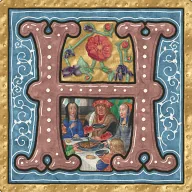
The initial: The wassail bowl carried from door to door. Painted after J. Paul Getty Museum, Ms. Ludwig IX 18, fol. 21v.
Tunes like Here We Come A-Wassailing
- The Londonderry Air slow air in G
- The Holly and the Ivy slow air in G
- It Came Upon the Midnight Clear slow air in G
- Coventry Carol slow air in G
- The Meeting of the Waters slow air in G
- The Kesh jig in G
- The Rakes of Mallow polka in G