 Old Whistle
The Fairies’ Hornpipe
Tin whistle notes · hornpipe in G major
A G hornpipe in two parts; it climbs high into the second octave.
The notes, bar by bar
For a D whistle (the usual one). ’ is the second octave: same fingers, blow a little harder. # is sharp.
Part A
D G F# G A B D’ C B A G A B G B C D’ G’ F#’ G’ E’ D’ C B C E’ D’ B A B C D’ G’ F#’ A’ G’ F#’ E’ D’ E’ D’ C B A G A B C A D’ C A F# G G G G
Part B
B C E’ G’ G’ F#’ G’ F#’ E’ D’ E’ D’ C B A G A B C A E’ D’ C B A D’ D’ D’ B C D’ G’ G’ F#’ G’ F#’ E’ D’ E’ D’ C B A G A B C A D’ C A F# G G G G
Fingering chart for this tune
Every note The Fairies’ Hornpipe uses, low to high. A filled hole is covered; the top three are your left hand, + means blow harder.
How to play it
A hornpipe is in 4/4 but slower than a reel, played with a dotted, swung lilt, and its parts often end on three stamped crotchets.
46 of its 113 notes are in the second octave (marked ’): blow a little harder, with the same fingers.
It needs C natural (cover holes 2 and 3, or half-cover hole 1).
At a glance
- Kind
- Hornpipe
- Key
- G major
- Time
- 2/4
- Shape
- 2 parts, 18 bars as written
- Range
- D to A’ (both octaves)
- Level
- 6 of 10, harder
- Tempo
- 40 to 75 beats a minute in the app
Sheet music
The sheet music appears here.
Where it comes from
Setting: O'Neill's Music of Ireland (1903), no. 1718, p. 319.
In the app it belongs to Geantraí, the strain of joy: early Irish tradition asked every harper to master the three strains of sorrow, joy and sleep.
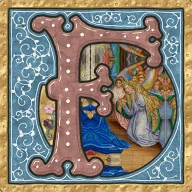
The initial: The fairies hornpipe. Painted after J. Paul Getty Museum, Ms. Ludwig IX 18, fol. 92v.
Tunes like The Fairies’ Hornpipe
- The Cuckoo’s Nest hornpipe in G
- Off to California hornpipe in G
- The Boys of Bluehill hornpipe in D
- The Humours of Ballyconnell hornpipe in A
- The Stack of Barley hornpipe in G
- The Blackberry Blossom reel in G
- The Woman of the House reel in G